“In the United States, approximately 462,000 individuals are incarcerated in local jails without an actual conviction.” – Prison Policy Initiative
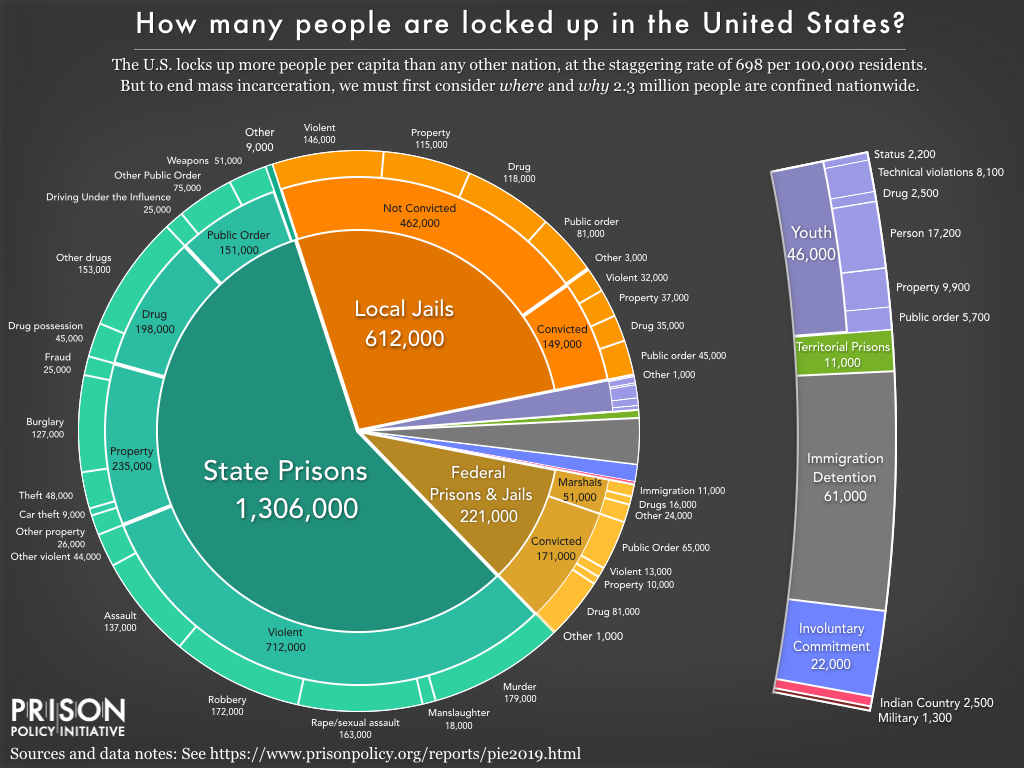
In theory, Bail seems like a pretty straight-forward mechanism to ensure that defendants appear at their court date. Bail is a sum of cash that the court demands from the defendant, with the promise of its return at the court date. If a defendant is unable to pay the set bail price, the defendant will be locked up until the trial. But this is where the trouble starts. Many people are locked up on bail for minor crimes, without even being convicted yet. Pre-trial incarceration has very significant effects on the outcome of cases. In both felony and non-felony cases, conviction rate is significantly higher (Billings). Bail has become a tool used to further the sentencing disparity between rich and poor. In this essay, I will review the current methods of bail-reform in order to highlight bail-reform’s current issues. I will then interdict with an explanation of the crux of the bail-reform issue and derive possible ways to address the underlying cause – the bail-bond industry.
The Reform
The current conversation about bail reform is primarily focused on the effectiveness and validity of risk assessment tools. Risk-assessment tools are statistical algorithms used to determine the danger and flight-risk of a defendant. While risk-assessment is a necessary step in the bail-setting process, academics contest the effectiveness of risk assessment. According to John Koepke and David Robinson, the current risk-assessment tools are not good at keeping defendants from having to pay bail. On the other hand, Thanitia Billings claims that using risk-assessment tools are in fact beneficial. Whether risk-assessment is effective or not is largely irrelevant, as reform efforts need to be directed at the economic incentive of bail-bond companies, and focused on preventing the influence of a profit driven industry.
A closer look at the risk-assessment issue
Current risk-assessment methods have produced conflicting results; with some area’s of the US finding success and others finding a distinct lack of success. The core of the disparity between these results lie in the factors used in the risk-assessment algorithm. Risk-assessment algorithms work through creating an equation out of factors that influence a defendants flight risk and danger to the community. Each defendant receives a score from the risk-assessment algorithm that supposedly represents how much of a danger they are, as a flight risk and to the community. When first implemented, many of the original algorithms used historical data which led to “Jurisdictions often not measur[ing] the changing landscape of the actual risks their defendants face[d]” (Koepke, 1730). If this were still true for the current algorithms used in risk assessment, then pre-trial bail imprisonment would not have seen decreases through the use of risk-assessment algorithms. Koepke’s criticism stems from a larger, underlying issue – the obscurity inherent in these algorithms. Koepke argues that judges are at risk of placing too much trust into the algorithm, without actually understanding how it works. The unwarranted trust placed into the algorithms results in what Koepke describes as “an imprimatur of scientific objectivity” (Koepke, 1730). Simply because the algorithm spits out a number proclaiming the defendant’s “dangerousness” does not mean that the number is in any way accurate. The temptation judges face to just accept the danger-rating at face value and leave it at that is definitely a consideration when implementing risk-assessment algorithms. In the same line of thought, with vague terms such as “dangerousness”, each individual jurisdiction can find lots of power to distort the algorithms. Such power can lead to a backfire in the reform movement if and when a jurisdiction justifies a continuing trend of high bail imprisonment rate with this “scientific” algorithm. Koepke is correct in pointing out all of these concerns.
Billings directly contrasts Koepke’s concerns through her presentation of the Broward County study. Broward County, Florida felt pressure to ease the growing numbers in their jails, so they attempted to reduce the amount of defendants detained for bail. Broward County doubled their budget for Pre-trial Release Service Agencies (PSAs). And how do Pre-trial Services work? They use statistical-risk analysis tools. On top of that, the PSA discloses how “the PSA does not rely on factors such as race, ethnicity, or geography (Smith).” The transparency from Pre-trial Services removes the sense of false objectivity feared by Koepke. The main reason that PSA’s are much more transparent with their risk-assessment algorithms is because the responsibility for effective risk-assessment is centralized in a single organization. The PSA assumes an accountability that would be hard to find if it were spread out over many small jurisdictions. Further evidence supporting the use of PSAs in Broward County is seen when PSAs are removed. A few years later in Broward County, their “Commission voted to significantly scale back the use of PSAs (Billings, 1338).” The resulting consequence was a severe increase in incarceration in Broward County. These findings presented by Billings extend far past the domain of correlational relationships and into the realm of causal relationships. Despite all of this evidence, there is only so much we can derive from a single instance of PSA use. A necessary consideration for an organization such as the PSA to take into account are the individual variants found throughout the country. No one place should use the same factors for risk consideration, as no one place is the same. This logic seems pretty standard, and appears to be acknowledged by the PSA, at least between Florida and North Carolina. Locally, Mecklenberg County implemented PSAs into their bail-setting consideration. The use of PSAs in Mecklenberg has shown that “bail reform can reduce pretrial detentions without significant impacts on [failure-to-appears] and public safety (Smith).” Many places show improvement through the use of PSAs and statistical risk-assessment tools. Broward County, Florida is likely very different compared to Mecklenberg County, North Carolina, yet both areas are seeing improvements with PSAs. Koepke claims that statistical risk-assessment is still in it’s enfancy, and is not ready for use. Billings’ study directly contrasted Koepke’s sentiment, providing empirical evidence supporting the effectiveness of PSAs.
Deriving the bigger issue through the risk-assessment issue
Despite the effectiveness of risk-assessment bail reform, seeing statistics change on paper is very different from obtaining a fair bail system. Case in point is the story of Tyrone Tomlin[1]. Tomlin was stopped by a police officer after buying a soda from a discount market. After a frustrating interaction in which the police searched him for drugs, the police officer confiscated Tomlin’s soda straw as drug paraphernalia. Tomlin had been to prison for vehicle and drug related charges in the 80’s and 90’s. Previously scarred by the prison-industrial process, Tomlin was still struggling to find a permanent job 20 years later. In his court meeting, Tomlin refused to plead guilty, not only because he is innocent, but because it would further blemish his criminal record. The court set a bail at 1500 dollars, a price well outside of Tomlin’s ability to pay. The next action the court did was to send the straw in for testing. While the straw was sent to forensics for testing, Tyrone was sent to Rikers prison in New York, a notoriously brutal prison. The court took three weeks to determine that there were no drug traces on his straw. In all of that time, Tomlin was in Rikers. In fact, the report detailing Tomlin’s innocence was completed and sitting in an office for 10 days before Tomlin was released. In that time period, Tomlin was pretty severely beaten by other inmates.
Because both Koepke and Billings acknowledge the continuing need for bail reform, and Billings presents strong evidence explaining how risk-assessment is doing the job it is supposed to, something else must be at play here: namely the economic interests of the bail bond industry. Even the states find benefit from reducing the amount of people on bail, by easing the expanding prison population and the strain that results from a large prison population. The only group with an interest in keeping people locked up on bail is the bail-bond industry. In our earlier example of Broward County, “in the year preceding the vote to scale back PSAs, bail bond companies donated thousands of dollars to county commissioners’ campaigns.” The economic incentive for bail-setting is what sustains the bail discrepancies, so focusing reform efforts on the risk-analysis methods is like focusing on hiding the symptoms of a cold rather than attacking the cold itself.
The only way to get rid of a weed is to attack it from the roots – meaning that bail reform should be focused on removing the profit incentive of bail-bond companies. The most probable way of removing the bail-bond industry’s economic motive is to create a bail system that is not dependent on money. One way to take money out of the equation in bail-setting is to create a bail system based on reinforcement instead of consequence. A possible solution is if the defendants are promised a milder sentence by showing up, and on top of that were threatened by the promise of a harsher sentence on top of their arrest warrant if they skipped their trial. Whatever solution we come up with, successful bail-reform is essential. We must have a just bail system in the Untied States, not only because it is a strain on tax payer dollars, but more obviously because anything less is a violation of basic human rights.
Honor Code: Douglas Deutsch
Bibliography
Billings, Thanithia. “Private Interest, Public Sphere: Eliminating the Use of Commercial Bail Bondsmen in the Criminal Justice System.” Boston College. Law School. Boston College Law Review; Newton Centre 57, no. 4 (2016): 1337–65.
Koepke, John Logan, and David G. Robinson. “Danger Ahead: Risk Assessment and the Future of Bail Reform.” Washington Law Review; Seattle 93, no. 4 (2018): 1725–1807.
Pinto, Nick. “The Bail Trap.” The New York Times, August 13, 2015, sec. Magazine. https://www.nytimes.com/2015/08/16/magazine/the-bail-trap.html.
Smith, Jessica. “Study: Mecklenburg County’s Bail Reforms Lead to Increased Release Rates but No Significant Increase in FTAs or New Criminal Activity.” NC Criminal Law Blog | UNC Chapel Hill School of Government (blog), June 20, 2019. https://nccriminallaw.sog.unc.edu.
Vizzuality. “Public Safety Assessment (PSA).” Accessed November 13, 2019. https://psapretrial.org/.
Wendy Sawyer, and Peter Wagner.
“Mass Incarceration: The Whole Pie 2019 | Prison Policy Initiative.” Accessed
December 7, 2019. https://www.prisonpolicy.org/reports/pie2019.html.
[1] The story of Tyrone Tomlin is pulled from the New York Times article “The Bail Trap” (Pinto).
