Douglas Deutsch
Our Changing Society
In discussions of the internet, there is a lot of controversy over the consequences of society’s increased digital use on our brain. One particularly polarized area of this argument is how the architecture of the internet affects our brains compared to print and oral communication. Nicholas Carr claims in his essay “Is Google Making Us Stupid?” that internet use causes our minds to atrophy. Kathleen Fitzpatrick demonstrates her support for the opposing argument that the internet transforms the way we interact with literature in her essay “Reading (and writing) online, rather than on the decline.” My own view is that the internet produces some previously inconceivable benefits, but it is, at the very roots, changing how our minds work.
I was aimlessly perusing the web when I saw the first article. Before I read that abstract, I had no idea that cognitive psychology would be right up my alley. The abstract was as far as I would read though, because I quickly got diverted to another article when the paper mentioned neuroeconomics. Although everything I was reading was all under the “decision-making science” umbrella, I ended up jumping from abstract to abstract, retaining only a superficial knowledge on a number of relatively disparate subjects. Carr describes this type of literary consumption as “power brows[ing] horizontally through titles.” Human minds were never designed for sustained, deep thought, so they naturally gravitate towards the “power browsing” Carr describes, but deep thought can be developed through practice. As our society becomes more integrated into the digital world, it becomes increasingly difficult to practice deep thought. This is where the dichotomy of the issue reveals itself. As the academic world merges with the internet, the cornerstone of academia – deep thought – gets stripped down.
Kathleen Fitzpatrick argues that the community the internet brings outweighs the side effect of fractured mental ability. She is not completely wrong. The internet allows for a diversity of thought that was impossible in print literature. As far as the tendency to power browse, that is the individual’s responsibility, is it not? Ideally we would benefit from the best of both worlds: academics would fully absorb and spend time with a diverse selection of literature. For a minority this may be the case. Unfortunately for the rest of us, all human minds were designed, as miraculous as they are, with flaws. These flaws are consistent among everyone. They include the tendency to take shortcuts and preserve energy through preconceptions, biases, and instant gratification. The instant gratification from jumping between abstracts prevented me from spending time and thought with a single case study. Humans are massively susceptible to what psychologists call “primes”; unconscious triggers that affect how people act. It is in the best interest of the companies who run the internet to prime visitors to respond to instant gratification. It keeps people online longer, equating to more money for them. In psychological studies on primes, interestingly enough, the primes had little effect if the participants were warned about them beforehand. This finding suggests that internet users educated on the primes of the internet are potentially immune to them.
The debate can be looked at from many different perspectives, but boiled down to it’s core, the debate is about the individual’s responsibility to use healthy literary consumption. It is easy to say that the responsibility lies with the individual until we realize the very little control we have over how we act on the internet. This susceptibility is something that we can overcome, but placing the epicenter of academic activity in a medium designed to wear away attention seems, at best, unwise. It is the responsibility of the companies who run the internet to transform it into a more welcoming medium of information, and our job as the users to be wary of the dangers that lurk behind the internet’s benefits.
Honor Pledge: DD
Sources:
Carr, Nicholas. “Is Google Making Us Stupid?” The Atlantic, The Atlantic, July 2008, www.theatlantic.com/magazine/archive/2008/07/is-google-making-us-stupid/306868/. Accessed 9 Sept. 2019.
Fitzpatrick, Kathleen. “Reading (and Writing) Online, Rather Than on the Decline.” Profession, vol. 2012, no. 1, Dec. 2012, pp. 41–52, 10.1632/prof.2012.2012.1.41. Accessed 6 Mar. 2019.
Kahneman, Daniel. Thinking, Fast and Slow. New York, Farrar, Straus And Giroux, 2015.
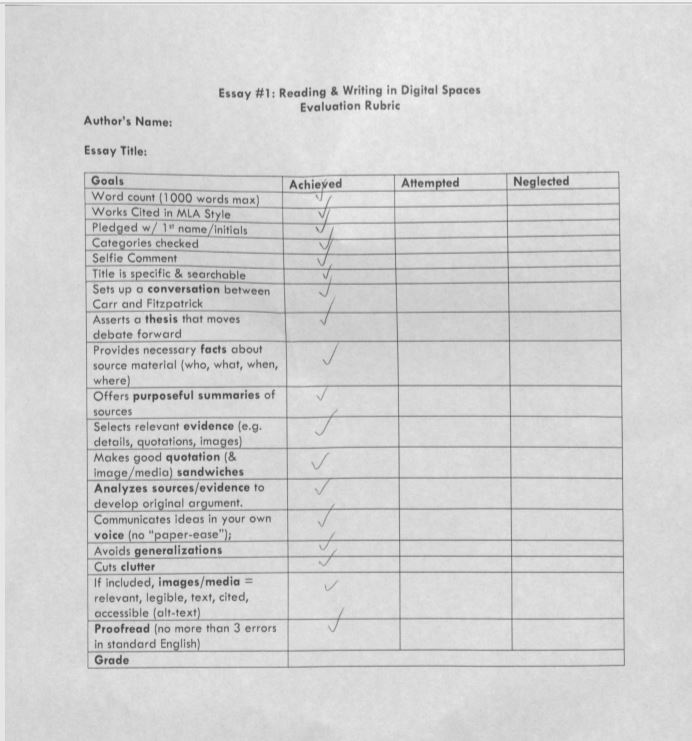

The greatest strengths of this fast-paced, wide-ranging, thought-provoking essay lies in the original insights offered in the conclusion, notably this claim: “It is easy to say that the responsibility lies with the individual until we realize the very little control we have over how we act on the internet.” I’ve read lots of essays about user responsibilities, but you’re the first to point out that the internet is structured to undermine our impulse control so that it can control our behaviors. You claim that we can overcome this susceptibility (but don’t explain how), yet offer the warning that “placing the epicenter of academic activity in a medium designed to wear away attention seems, at best, unwise.” You build a bridge from the internet’s general features to the academic mission, perceptively pointing out the incongruity. This incongruity is the crux of your argument—the intellectual knot that needs untangling—and it’s a brilliant one.
Instead of untangling it (because by now you’ve reached the end of your essay), you conclude simply that companies should do better, and “our job” is to be “wary of the dangers.” In this way, you switch from an academic problem to a business/career emphasis. This rapid shifting of focus, from one good idea to the next, characterizes the logic of the essay. I’m intrigued by each point (you make so many interesting claims!), but the claims don’t cohere into a persuasive argument. Take, for example, your second to the last paragraph, which announces itself to be about Fitzpatrick’s argument that the internet generates community. But the paragraph doesn’t say anything else about community; instead we learn about power browsing, human flaws, and primes—all fascinating topics, but not ones that cohere to support a single claim.
Given your original thinking and linguistic fluency, you can solve the problem of “many good ideas without a coherent argument” by narrowing your thesis from the very general claim you offer initially (the internet has benefits but changes our brains), to the more specific crux problem: As scholars, we have an ethical responsibility to use the internet wisely, yet the internet is designed to erode our control over our actions and behaviors. This problem leads to the question: is the academic mission incompatible with the corporate logic that now controls the internet?
When you start with a more specific question, you paradoxically have more to say. From a specific thesis, make sure each paragraph introduces a new claim related to that thesis, provides evidence to support it, and analyzes the evidence to show how it supports your argument. And finally, eliminate your dependence on sentences beginning with “this is” and “it is,” because they create conditions for vague, abstract subjects. Think of them as headless zombie sentences.
What I want to emphasize most is the intellectual power of your writing, which is rooted in good, substantive ideas. Your synthetic intelligence sees connections between ideas and concepts and pulls them together. That’s a great strength, which you can use to pull concepts together in a more organized way in order to support and develop a specific, original thesis.
also please change your settings so comments don’t need approval!