Douglas Deutsch
“We long for timelessness, we endure the passing of time: we suffer time. Time is suffering.”
Carlo Rovelli, The Order of Time
As Bechdel guides us through her memories, we catch a glimpse of Bechdel, the author not the character. Alison is a perception of Bechdel, an image of the author from a singular point of view. Scott McCloud explains in his graphic work Understanding Comics the concept of “Icons” and their purpose in representing Ideas (pg. 27). McCloud demonstrates this point by placing images of different objects with a caption that contradicts the existence of said object.

Jennifer Lemberg contends that visual art gives Bechdel the ability “to express ideas that her writing cannot support” in her essay Project MUSE – Closing the Gap in Alison Bechdel’s Fun Home (pg. 9). And while Bechdel is expressing idea’s more fully through the medium of comics, she is still telling her story through icons. Because of this, Fun Home is not about real life Bechdel, but an Alison, however true to life, that is fictional. Bechdel uses Alison to, as Lemberg would describe it, “bear witness” to her past traumas. She uses Alison as a tool to dive into an introspection of her past, in an attempt to break through her father’s “skillful artifice [used] to make things appear to be what they were not.” We as the audience must derive the real story from what is presented to us in details, using the fixed viewpoint of Alison to take us as close as possible to the convoluted meaning behind the pictures and words.
Throughout the memoir, Bechdel gives more detail to the background than the characters. On top of that, Alison is assigned much less visual acuity than any of the other characters. McCloud asserts that “when we abstract an image… we are not so much eliminating details as we are focusing on specific details,” and Bechdel is a maestro at channeling our attention. The lack of detail in the character depictions allow the reader to place themselves in the story, and gives the memoir a much more intimate perspective. Take the top panel on page 98 for example.
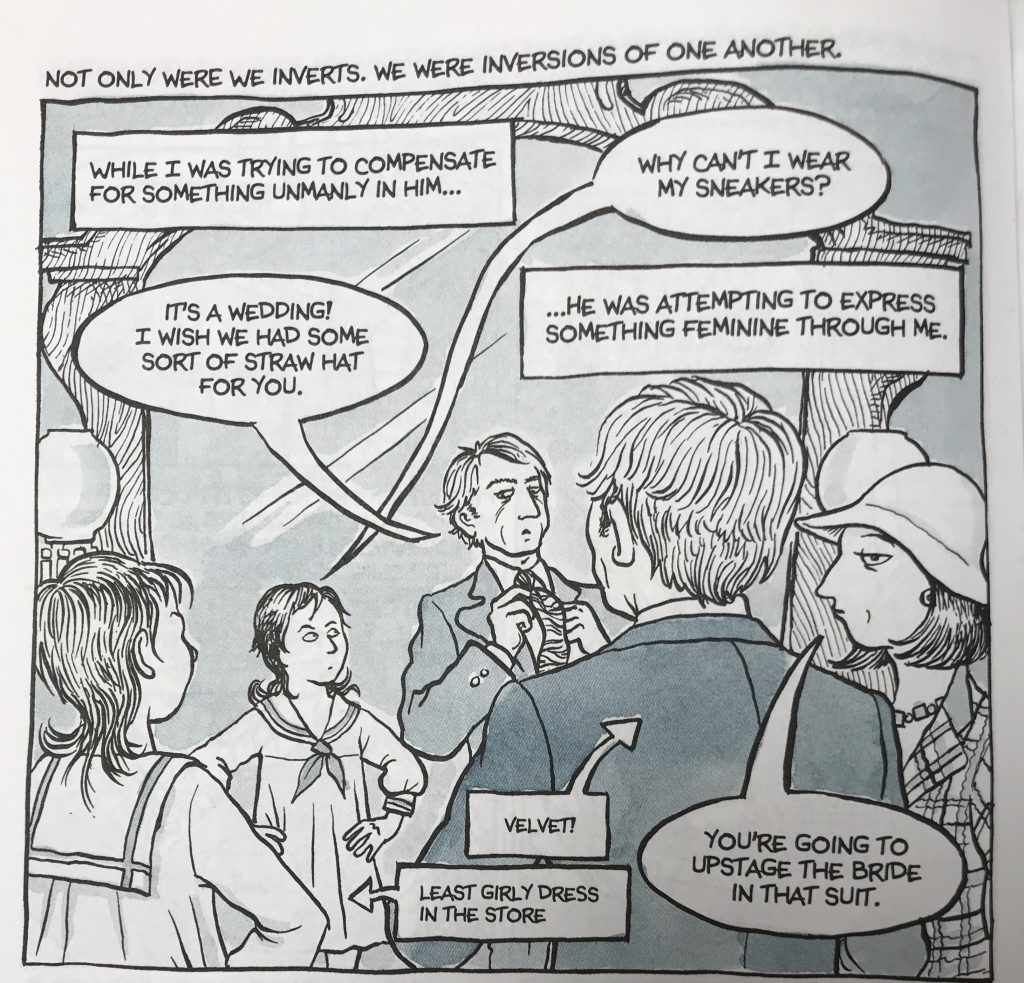
Notice how the eye is whipped through the panel in a twisted manner. The distribution of detail in this scene draws us first into the most abstract, in Alison, and then winds us through the frame based on the gazes and speech bubbles. More importantly, the difference in detail between the characters and backgrounds creates a noticeable distinction that ebbs and flows with the plot. In the beginning of the memoir, Alison’s house is depicted with meticulous detail, sharp in contrast to the detail placed in the characters. Even within the context of the character drawings, Alison has considerably less detail than any of the other characters. The difference is particularly noticeable between her and her father, emphasizing the disparity Alison initially feels toward her father. As Alison becomes older in the memoir, the relative difference in detail between the characters and background diminishes. This underlying trend comes to a climax on page 123, when Alison dreams of her father shortly before he dies.
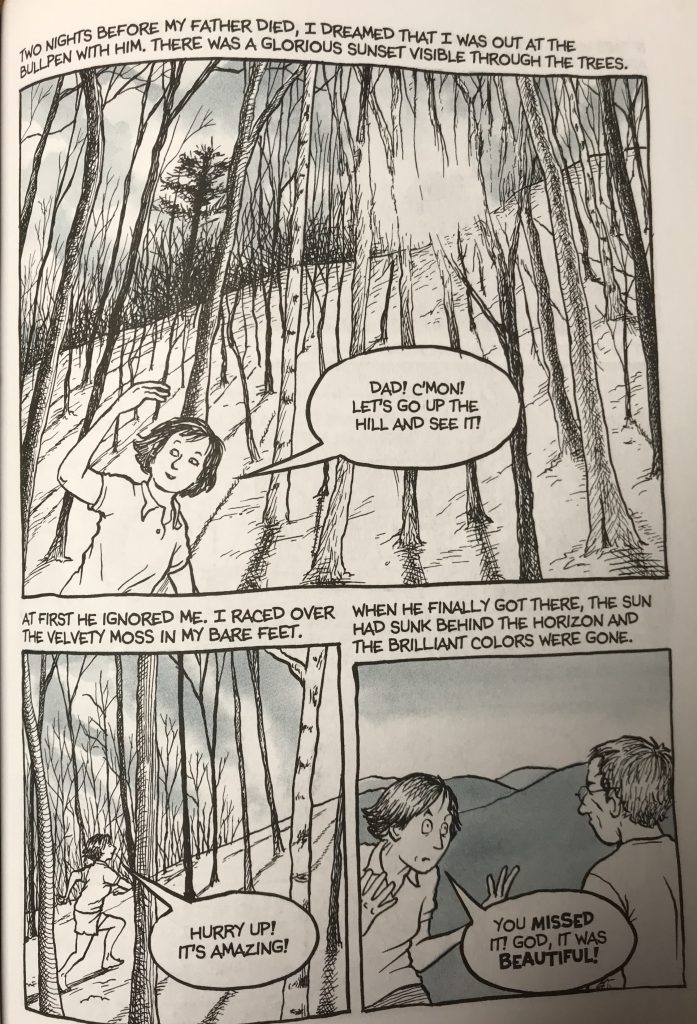
Figure 3 – Fun Home Dream Sequence 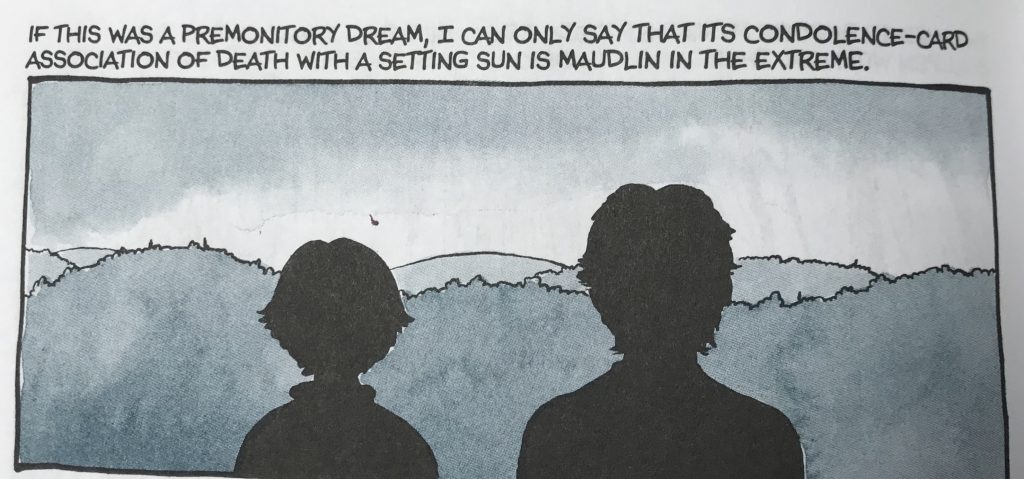
The dream takes place in a minimalistic forest, and the lack of detail placed in Alison’s father’s face comes into shocking contrast with the detail finally found in Alison’s face. The final panel of the dream sequence shows Bechdel and her father in silhouette, expressing their similarities and unity. The pattern of detail shown above signifies that Alison has come to fully realize her father’s queerness.
It is fitting that Alison fully realizes her father’s queerness in a dream. As Alison begins to come to terms with her father’s queerness, we realize that her trauma is too complex and multi-faceted to be merely “validated” as argued by Lemberg. This turning point where Alison’s closure is foreshadowed is given an ethereal quality, a timelessness lent by it’s dream state. The rest of the panels are based off of memory and supplemented by pictures and notes, giving an abstractly linear direction of the time through the memoir. Just as we have all of our memories in a jumble in our heads at once, but can place each memory linearly in time as we recall it, when Bechdel places her memories into Fun Home, we unconsciously organize them into a linear story. The main exception to this is when Alison achieves her closure in the memoir. The stunningly beautiful parallels drawn in the final pages of the memoir are only made possible through the seeds planted earlier in her dream sequence. These two events put into perspective all of Bechdel’s memories. They act as a timeless backbone that underlies all of the events of the memoir. The paradox of the most subjective event in the memoir acting as the backbone of the memoir only further emphasizes how truly complicated Bechdel’s trauma is, and how she simultaneously emphasizes with her father and
The parallels between Bechdel and her dad only highlight their differences, portraying Alison as the version of Icarus that never crashed, the version that had the trials and errors of the previous Icarus to guide her. Ultimately, Fun Home was never about Bechdel or Alison, but about the relationship between them and her father. The story portrayed is a biography between the lines, a tale derived from the combined experiences of two outcasts. Bechdel is not looking for personal gain or validation through writing this. This memoir is simply an ode to the complexity of a single relationship. To claim the Bechdel wrote Fun House for personal validation is an insult to both her and her work. We can see through the implementation of detail how the emotion behind the memoir transcends the story, how we can glimpse her real life behind the abstracted cartoon characters, all because her details tell us where to look to find meaning. The aggregation of all of these little details work to display the emotional crux of a beautifully tangled story.
Sources:
Lemberg, Jennifer. “Closing the Gap in Alison Bechdel’s Fun Home.” WSQ: Women’s Studies Quarterly, vol. 36, no. 1–2, 2008, pp. 129–140, 10.1353/wsq.0.0051. Accessed 16 Aug. 2019.
Chute, Hillary. “Gothic Revival.” Villagevoice.Com, 2017, www.villagevoice.com/2006/07/04/gothic-revival-2/. Accessed 30 Sept. 2019.
Mccloud, Scott. The Invisible Art Understanding Comics. Ny Harpercollins Publishers, 1994.
Honor Code – DD

This is your best essay yet, and your perceptive, original intelligence is now channeled into a more coherent, focused argument. You do a good job setting up a conversation with McCloud, though his concept of masking is more appropriate than his more general concept of icon, is masking is setting iconic faces against a detailed background, so that we identify with the characters. Your insights about the dream sequence are fascinating! You’re so perceptive to see how in this sequence faces and backgrounds suddenly match, which may in fact limit our ability to insert ourselves into the scene. Then we we see silhouettes, do we plug ourselves back in, or are we further shut out? In any case, Bechdel seems to want to preserve this pivotal moment for herself and her father.
I wish I could see the scene you compare it to at the end, because doing so would help me understand what you’re saying about how the dream scene relates to closure in the novel. You’ve also got a subtle and valid beef with Lemberg, about how the memoir is not simply about self-validation, but about relationship. In fact, I think that idea is your real thesis, and you could subordinate the McCloud technique of masking to show how she points our attention to relationship.
The moves to keep practicing are purposeful summaries and quotation sandwiches (with evidence to support each claim). The ideas seem so clear in your capacious mind that you forget your readers don’t know what you know. Read your essay out loud, slowly, as if speaking to a real person to better hear how your sentences follow (or jump!) from one to the next. You’ll also catch typos and style errors this way.
see hypothesis for more comments!